Since 2001, PlanningForce has worked on one central question: how can organisations better steer their commitments, resources and constraints without forcing the plan or exhausting their teams? That experience now shapes our purpose and the way we co-create solutions with clients that truly fit their reality.
PlanningForce was born in 2001 in a research laboratory at the Faculté Polytechnique de Mons, around a question that is harder than it seems: how can people and resources be planned according to their real capacity, without forcing the plan or exhausting teams? For twenty-five years, we have deepened our knowledge of this central subject: tactical, operational and real-time planning systems, simulation tools, constraint-based planning algorithms, intelligent reporting, decision workflows, and more. Most of our team members have been here for more than fifteen years — four of us from the very first day. Expertise does not leave the company. It remains deeply anchored in our people and our systems, grows richer year after year, and explains why a small team can be called in by very large organisations.
Each ring in the tree of PlanningForce knowledge represents a year in the life of our company: software engineers, algorithm specialists, developers, organisational steering consultants and managers growing their know-how and putting it at the service of what we have become. Today, we try, humbly, to pass that know-how on through the projects we now co-create with you, our clients and partners, on the RAPSODI platform.
Twenty-five years, roughly 120 organisations and a very stable team: that is the human and technical foundation of PlanningForce.
The people who shaped PlanningForce, by year of arrival · four since 2001 · most for more than fifteen years
Our purpose guides the way we approach management problems, design solutions with teams and measure our societal impact over time.
By involving all relevant stakeholders in the co-creation process, we aim to design systems that give leadership teams, business functions, support teams and operational teams a shared reading of reality. Everyone should be able to understand trade-offs, contribute to them and see what they mean for their own work and for their colleagues.
We design systems that help reduce waste and unnecessary tension while protecting teams, equipment and critical materials from overload, breakdowns or shortages. Our experience shows that every organisation has productivity reserves it can mobilise, with our help, for the benefit of all its stakeholders.
We want our systems to help clients move their practices towards a circular production model, or at least towards one that is more respectful of planetary boundaries. For us, sustainability starts with the way production processes are modelled and with the ability to measure, before decisions are made, their impact on environmental commitments.
Working with PlanningForce means starting from reality: usage, constraints, people, available data and the decisions that need to be clarified. It also means moving towards a solution that will durably change the way the organisation is steered, beginning with its performance and value indicators.
We start from roles, practices and field constraints before freezing a screen, an indicator or a workflow.
A solution should help people see the consequences of a choice before it becomes costly or difficult to correct.
We do not build systems that hide overload or artificially force the plan.
Solutions must be able to evolve, be understood, maintained and owned by the teams who use them.
Performance is not only about deadlines or budget. It must also take account of people, partners, clients and the environment.
Steering organisations in the age of value sets out one conviction: to withstand crises, and even grow stronger through them, organisations need to understand where value lies within them and how new classes of tools and methodologies can help mobilise it for the benefit of all stakeholders.
Reading it before starting a project with us helps clarify how we approach management problems: what the organisation truly needs to steer, why it needs to steer it, and for the benefit of which stakeholders.
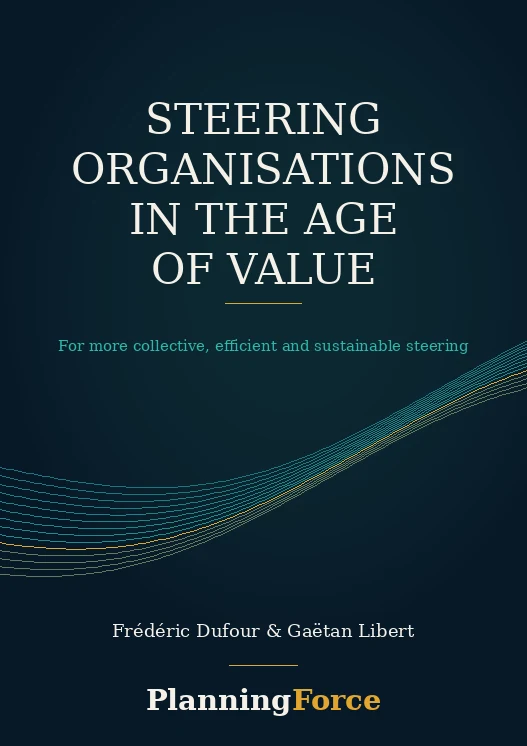
Our book proposes a new management paradigm to help organisations become more robust, more human and more useful to society. Through the concepts of the value organisation, the value fractal and digitalised steering, it offers leaders a framework for better decision-making, better cooperation and sustainable value creation for all stakeholders.
A first conversation often helps clarify the value to be created, the stakeholders involved and the decisions that deserve to be better informed.